Showing posts with label cow's milk. Show all posts

Friday, October 21, 2011

Saving the best for last

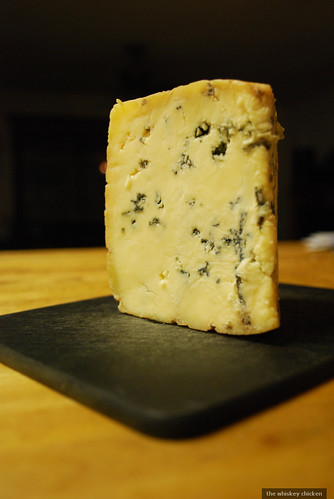
Mystery Blue


  Well, after a rather long blogging hiatus that I will most certainly explain to you in coming days, let's talk about cheese! After a very long work day while host to a cold, driving home in rush-hour traffic and pouring rain, then coming home to a dark and empty house....what would you long for? If you were me, it would be a little white box sitting on your fence post that read "Perishable" and a hard to find winter warmer beer.
  My little white box contained the latest and last installment of the "Birth of a Cheese" series by Point Reyes Dairy and Culture Magazine. A lovely "mystery" blue that I was chomping at the bit to pair with the Founders Backwoods Bastard ale I had securely in my possession. The last blue Point Reyes sent me was very lovely, but admittedly not my favorite. This blue was a world apart.
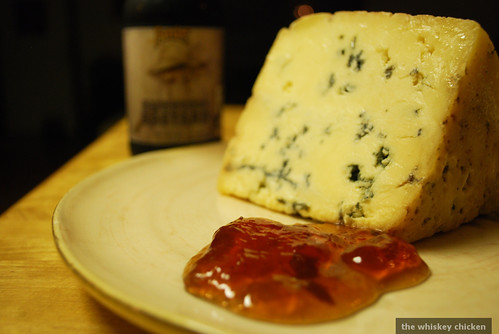
  At first glance the appearance was similar to "mystery #1", with a pale yellow creamy look, gorgeous even blue veining, and a straw colored rind. The smell was slightly stronger. Spicy and sweet, like fresh hay. But the first bite was a revelation, so much more than batch one. The texture was incredibly luscious and dense, almost chewy. It was everything I hope for in a blue. The flavors from center to rind varied from brown sugar and young hay to damp earth and roasted nuts. The rind was subtle and totally edible.
  After first bite, I immediately grabbed up my Founders, a whopping 10.2% alcohol ale aged in Bourbon barrels. The sweet caramel and vanilla tones practically made love to the earthy grassy flavors of the blue. I couldn't think of a better beverage to pair with it, except for possibly a sweet hard cider.
  The following day I used some of the blue on a crusty baguette with romaine lettuce, mayonnaise, mustard, and rare roast beef for hot melty sandwiches. Then for a snack I paired a small wedge with rosy colored and sugary sweet muscadine preserves. Worked equally as well for cooking as did a table cheese. This will be a cheese I will for sure be eagerly waiting for at my cheese counter.


Blue & Jelly

Wednesday, August 31, 2011

Tomme Sweet Tomme


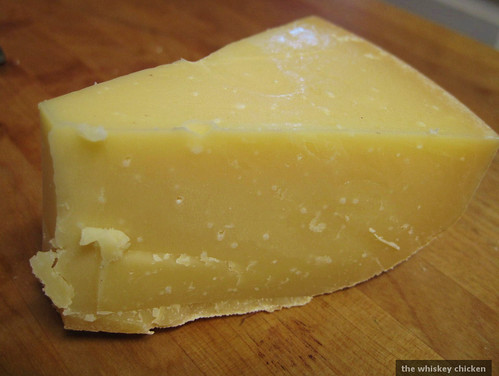
Point Reyes Tomme


  This past weekend I spent some time in Chattanooga, TN. Along with drinking multiple Yazoo beers and stuffing my face with delicious Urban Stack burgers, I also made my way over to Sequatchie Cove Creamery to meet the fine folks who craft such gems as Cumberland tomme. Later, I would come home to discover an entirely different tomme waiting for me.


Sequatchie Valley, TN

                                     
  Lucky me received another package from Point Reyes Dairy. While this one was not part of the official tasting, it was (I say was because it it quickly vanished into my mouth) very special in the sense that it is not available to the rest of the public.
  Having recently had the Cumberland, it was a fun comparison trying the Point Reyes tomme. While tomme is a style, the individual cheeses can all vary wildly. The Point Reyes was just as fantastic as Sequatchie Cove's example, but totally different. While the Cumberland is earthy, smooth, and somewhat soft, the Point Reyes was rather hard and crumbly. The paste was golden with large "crunchies" (amino acid clusters), and the nose was sweet, grassy, and tropical. The taste was surprising and fun; bright, sweet, salty, and bursting with lemon and grapefruit flavors. I made it a point to sample a piece with Yazoo's latest Hop Project. The tropical notes of the cheese danced around with the floral hoppiness of the beer, making a great pairing.
  The beauty in handcrafted cheeses like these is the individual uniqueness of the styles. These cheeses aren't mass manufactured, and that should be celebrated. My weekend of tomme made for a very sweet homecoming indeed. Tomme sweet tomme. Oh, I just couldn't help myself.
 

Tuesday, July 26, 2011

You say Tomato, I say Mozzarella

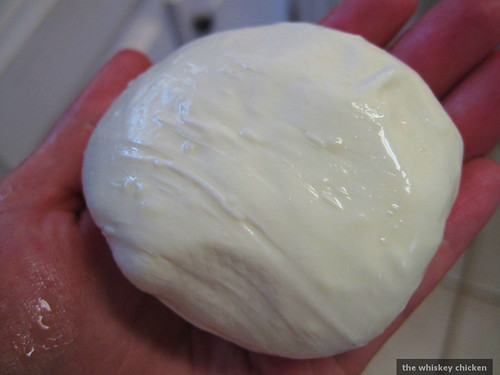
Freshly made Mozzarella


  This time of year is the pinnacle of tomato season. And with an overabundance of those acidic red orbs, comes a plethora of dishes that include basil and mozzarella. Now, while I admit that this trio has been overused much in the same way prosciutto and cantaloupe/asparagus has (and oh how it has...), there is a very good reason for it. It's tasty. You may be thinking Caprese salad, I am thinking pizza, but I am always thinking pizza. I like all sorts of bizarre wonderful toppings, but a classic Margherita is tough to beat.
  You could always spring for the stuff packed in water that's $9 a container, or you could make your own. Now, there are a few specialty ingredients needed to make fresh mozzarella, and you will probably need to order them off of the Internet. But most will last you for a long time, aren't terribly pricey, and can be used to make countless other cheeses. The New England Cheese Making Supply Co. is my personal favorite for such business.
  I would like to share with you how to make crazy delicious mozzarella at home, but first, I want to answer a few burning questions I know you have always had about the ingredients to come.


Q. What is rennet? Why the &*@! is it in my cheese?

A. Rennet is a mixture of enzymes that are traditionally derived from the stomach of a calf (or kid, or lamb) that aid in the coagulation of cheese, causing the milk to separate into curds (milk solids/future cheese) and whey (leftover liquid). It is usually the byproduct of the veal industry. Rennet can be bought as either a liquid, powder, or tablet. There is also vegetable rennet, microbial rennet, and Chymosin (or genetically engineered rennet). Vegetable rennet can be made from a number of things such as thistle and nettle, but is most commonly mold based for commercial rennet. Microbial rennet is also mold based, and can be very difficult to use in aged cheeses due to it's bitter taste. Chymosin is a rennet who's origins start as cow genes that are then spliced into bacteria to create a genetically modified rennet that can be considered suitable for vegetarians. Junket rennet tablets are a very weak form of rennet that will not work for aged cheeses. Besides, it has Junk in the name.


Q. What is Calcium Chloride?

A. Calcium Chloride is a salt solution that is used to restore the balance of calcium that is lost to heat treatment in milk. It helps to speed up the coagulation process when rennet is used.


Q. What is cheese salt? Sounds delicious...

A. Cheese salt is simply an noniodized coarse salt that is used to flavor the cheese. It is not cheese flavored salt. Kosher salt can also be used, as long as it is iodine free. Iodine inhibits lactic bacteria and slows down the aging process.


Fresh Mozzarella


Ingredients

1 1/2 teaspoons calcium chloride dissolved in 1/2 cup cool water
1 gallon pasteurized whole milk (if using raw milk, skip calcium chloride)
1/4 teaspoon liquid rennet dissolved in 1/4 cup cool, nonchlorinated water
1 teaspoon cheese salt


Special Equipment

large stainless steel pot
stainless steel slotted spoon
thermometer
heavy duty latex or rubber gloves


Pour milk into pot over medium/low heat.
When milk reaches 55 degrees, stir in calcium chloride mixture.
Heat milk to 90 degrees (milk will start to curdle).
Slowly stir in rennet mixture in an up and down motion while heating milk to 100 degrees.
Turn off heat.
When the curds get larger, start to pull away from the pot, and the whey is fairly clear, they are ready (3-5 minutes).
Using the slotted spoon, scoop out curds into a microwave safe bowl.
Press the curds to expel as much of the whey as possible.
Microwave the curds for 1 minute.
Put on gloves (trust me) and drain off whey, then knead curds as you would dough. Very, very hot dough.
Microwave two more times for 35 seconds each, kneading after each time.
Add salt after last heating and knead until curds stretch like taffy.
Roll curds into balls or squeeze in between the hole of your index finger and thumb as if you were making a cheese balloon, then pinch with thumb.
Eat right away while still warm and gooey, or store in water in refrigerator for up to a week.
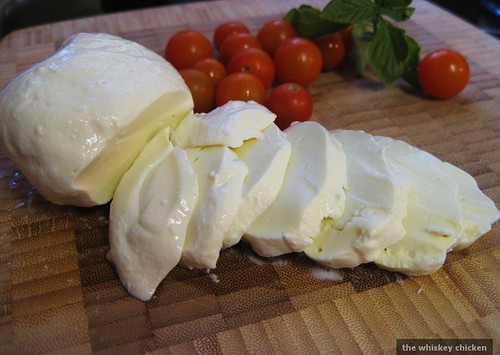


Fresh Mozzarella
Just add face


Thursday, June 9, 2011

Easy Cheese

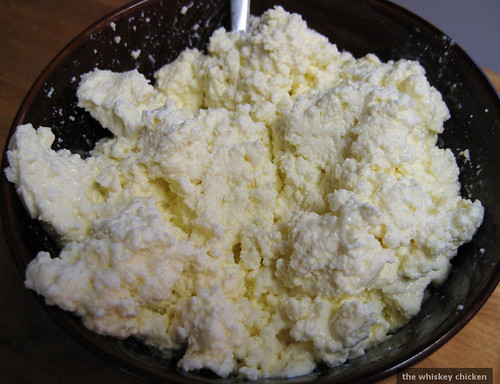
Fresh Ricotta


  With all of this meat curing that has been going lately, I admit I have strayed from my first true love. Just like with curing, cheese making can also be incredibly intimidating. There is so much involved: sanitation, science, a bit of alchemy, sensitive raw ingredients, crappy electric stove tops. But as with any new skill, it's best to start out with the basics and work (or rework) your way up. And so with making cheese, ricotta is about as basic and simple as one can get.
  Traditionally, ricotta was made from the leftover whey of cheeses such as Pecorino Romano. Reheating the whey after a make created a small fine curd that was used fresh, and often times derived from sheep's milk. Unfortunately, I don't have any sheep's milk hanging around in the refrigerator (yet) so common cow's milk will have to suffice. While ricotta can be made using leftover whey, it can be made from whole milk as well, which also increases the yield. All you need to form soft curds is a little heat and acidity. I use lemon juice, but a good quailty vinegar could be used also.


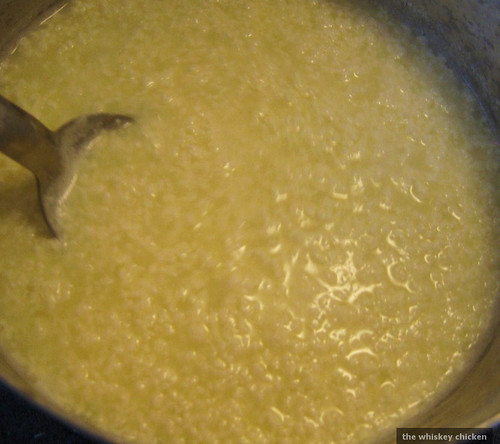
Ricotta in the Works
Cheese at Work


Fresh Ricotta (yields 2 cups)


Ingredients

2 quarts whole milk
2 cups heavy cream
1/2 tsp salt
3 T lemon juice


Line a colander with cheese cloth or butter muslin and set inside a large bowl.
Very slowly heat the milk, cream, and salt in a heavy bottom pot, stirring occasionally. (Do not walk away from milk on the stove to go check your email! No, not even if it will take "just a second"! It will boil over! Yes, I do it everytime)
When the milk comes to a slow rolling boil, add the lemon juice and stir until curds form, about 2 min.
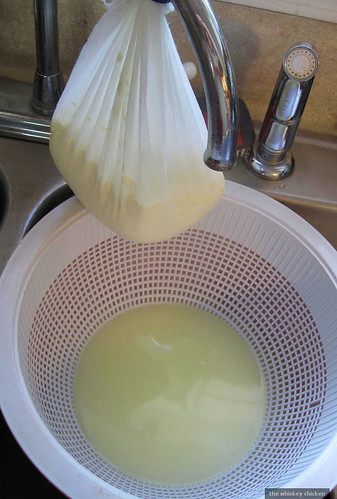
Pour curds into lined colander. You may need to suspend the cheese if your bowl is not deep enough, as I have done here with twist ties and rubber bands. Sophisticated, I know.


Draining Ricotta


Let the cheese drain for 1 hour. 
Remove the cheese and mix in a little heavy cream or milk for a smoother consistency if you like.
Save the whey for pancakes, biscuits, or smoothies.
Save your cheese cloth and wash it, it is reusable.
You can keep your lovely handmade cheese in the refrigerator for 2 days, but I can't imagine why it would stick around for that long. So good in pasta, in eggs, in pastries, I'm sure you can find plenty of uses for it.


  Since summertime in Georgia doesn't exactly scream lasagna weather, I adorned a simple pizza with mine. Piled high with fresh cheese, a hundred different vegetables from the garden/CSA, and served with a glass of cheap wine, it's nearly the perfect meal. Now, if I could only find time to make the damn crust...


Veggie Pizza
Summertime and the living's cheesy easy